手箱 · ABOUT
A box for your
precious code.
Tebako is short for tamatebako (玉手箱) — the legendary treasure box from Japanese folklore. The project gives the name new life: a portable fortress that carries a Ruby application safely to any destination.
THE NAME
Tamatebako — the treasure box.
In the folktale of Urashima Tarō, the princess Otohime gives the fisherman a beautiful casket as a parting gift. The box — thetamatebako (玉手箱) — was said to contain something precious. Its name breaks down as:
玉
tama
jade, precious stone
手
te
hand
箱
bako (hako)
box, casket
For this project, the metaphor fits. The application is the treasure — precious, crafted, irreplaceable — and Tebako is the box that carries it:portable, self-contained, and ready to be opened anywhere.
THE LEGEND
A fisherman, a princess,
and three hundred years.
Long ago, a fisherman named Urashima Tarōsaved a sea turtle from torment. In gratitude, the turtle carried him beneath the waves to the Dragon Palace — 龍宮城, Ryūgū-jō — a palace of coral and light at the bottom of the sea.
There, the princess Otohime welcomed him. For what felt like three days, he feasted, watched the dance of fishes, and forgot the world above. When he finally wished to return, Otohime gave him a gift: a small casket — the tamatebako, the treasure box — with a single condition.
Do not open it.
He returned to the shore and found everything changed. His village was gone. His family was gone. Three hundred yearshad passed in what felt like three days.
In his grief, he opened the box. White smoke billowed forth — and in an instant, the years caught up with him. Time, which had been held safely inside the box, rushed out all at once.
WHAT THE LEGEND TEACHES
The box held time.
The tamatebako held something precious: time itself.The days at the Dragon Palace were not lost — they were preserved, stored safely inside the box until it was opened.
Tebako does for code what the tamatebako did for Urashima's time. It preserves an application in a state of suspended perfection, frozen at the exact moment of packaging: no dependency rot, no version drift, and no bit decay affect what the box holds. The gems, the runtime, and the configuration all sit safe inside the box.
When the executable ships, its recipient receives a tamatebako of their own. They open it, and the application springs to life exactly as the packager built and intended it. No aging, no erosion, and no three hundred years of change separate the machine that built it from the machine that runs it.
This is what the project means by timelessness: code held outside of time, until the moment it runs.
THE LOGO
A gravitic cube over the ocean.
The Tebako logo is not merely decoration — it is the product, rendered as myth. It depicts a transparent cube floating above a stormy ocean at midnight, its edges glowing with the warm light of a single Ruby held within.
Every element carries meaning:
- Reverse gravity — the cube pushes away the turbulent waves below, creating a calm, self-contained space within. This is dependency isolation: the chaos of the outside world cannot reach what is inside.
- Heavy water walls — the cube's faces are sheets of dense water that refract light in strange ways. This is the DwarFS virtual filesystem: your entire application tree, compressed and mounted at startup, visible yet protected.
- A single Ruby — at the center floats your application, its warm glow illuminating the darkness. This is the code you wrote, running exactly as you intended, undisturbed by the storm.
On light
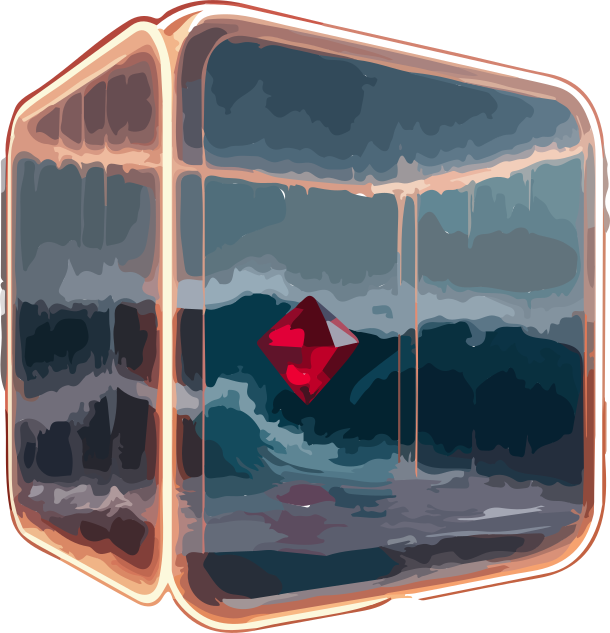
The transparent background lets the ocean and cube blend with the warm paper surface.
On dark
The midnight ocean becomes the page itself. The Ruby's vermillion glows against the dark.
WHY RUBY
The stone is a Ruby.
The gem inside the cube is red because Tebako was born to package Ruby. The deep vermillion of the stone — #c36242— is the color of a running application, of warmth, of something alive.
Ruby is a language built for developer happiness. Tebako extends that promise to the end user: the joy of writing Ruby becomes the simplicity of running a single file, with no gem installs, no version conflicts, and no runtime to configure. The box opens with a double-click, and the treasure glows inside.
THE COLORS
A palette from midnight and flame.
Every color in the Tebako identity is drawn directly from the logo illustration — the deep teal-black of the midnight ocean, the warm cream of the calm interior, the vermillion of the Ruby's glow.
Ink
The midnight ocean — depth, grounding
Paper
The calm within — clean surfaces, light
Vermillion
The Ruby's glow — primary actions
Gold
The emanating light — highlights
Amber
The warm halo — secondary glow
Slate
The storm clouds — neutral support
HOW IT WORKS
The box, opened.
Beneath the poetry is solid engineering. Tebako usesDwarFS — a fast, high-compression read-only filesystem — to pack an entire application tree into a single mountable image. At run time, the image mounts, and the application starts as if it were running in its original directory structure.
The Ruby runtime itself is patched, and it ships as two artifacts — the interpreter executable and its environment image — which tebako downloads once per machine, verifies, and mounts at run time, never extracting on POSIX. Native C extensions, gem dependencies, and configuration files all travel inside the box.
01
Press
One command packages the application.
02
Mount
At run time, DwarFS mounts the image.
03
Run
The Ruby application executes anywhere.
THE ECOSYSTEM